Tracing Authentication Protocols to Boundary-Setting Features Across Wireless Interactive Table Formats
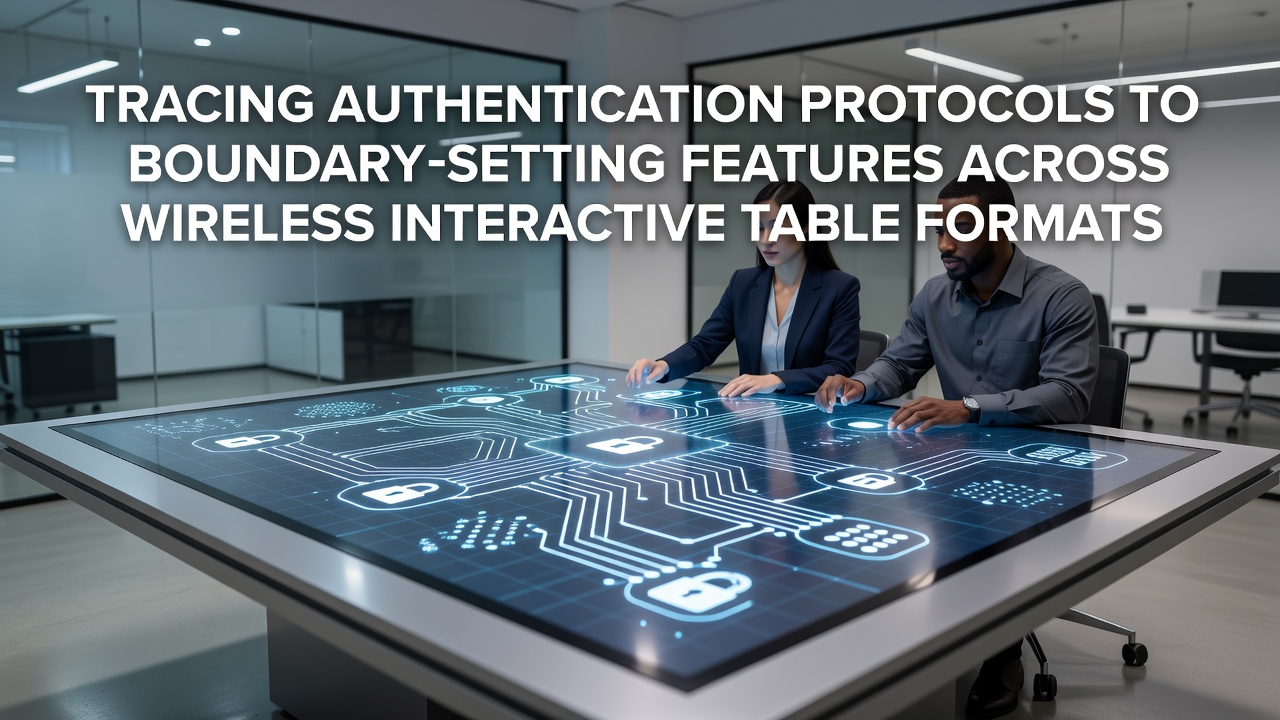
Wireless interactive table formats have evolved through successive layers of security integration that link user verification directly to access controls and operational boundaries. Researchers at technical institutes have mapped these connections by examining how initial authentication steps determine the scope of user interactions on shared surfaces that rely on wireless data exchange. Data from industry reports shows that protocols such as multi-factor verification and token-based systems feed into feature restrictions that prevent unauthorized modifications to table settings or content displays.
Core Authentication Mechanisms in Wireless Table Systems
Authentication begins with device pairing procedures that establish encrypted channels between user endpoints and the central table controller. Standards developed by organizations including the National Institute of Standards and Technology outline requirements for cryptographic handshakes that confirm identity before any interface elements activate. These processes incorporate biometric checks alongside traditional credentials, and the resulting session tokens carry embedded parameters that define permissible actions on the table surface. Observers note that tables deployed in educational and corporate environments often combine proximity-based detection with cloud-linked verification to maintain continuity across multiple users.
Boundary-setting emerges immediately after successful verification because the protocol assigns role-specific permissions that limit gesture recognition zones, content editing rights, and data export options. Engineers have documented cases where failed authentication attempts trigger automatic isolation of the table segment, preventing any further wireless input until re-verification occurs. This direct linkage reduces latency between login and feature availability while preserving audit trails for compliance reviews.
Integration of Protocols with Interactive Boundaries
Systems designers trace the flow from authentication outputs to boundary enforcement through middleware layers that translate verified identities into spatial constraints on the table interface. For instance, a verified administrator gains full control over wireless network parameters and multi-user synchronization, whereas guest profiles receive restricted zones that disable certain touch regions entirely. Studies conducted by European research consortia indicate that such mappings improve system stability when tables operate in environments with variable wireless interference.

July 2026 updates to wireless standards have prompted manufacturers to refine these linkages by incorporating adaptive boundary adjustments that respond to real-time signal strength readings. The adjustments maintain session integrity even when devices move around the table perimeter, and they automatically narrow editable areas if authentication strength drops below defined thresholds. Figures from hardware testing facilities reveal consistent reductions in unauthorized access events following these refinements.
Implementation Patterns Across Different Table Configurations
Rectangular and circular table formats demonstrate distinct patterns in how authentication protocols translate into boundary features. Rectangular layouts typically segment the surface into linear permission strips that align with user seating positions, while circular designs employ radial boundaries that rotate based on verified user orientation. Data collected from field deployments shows that both approaches rely on the same core protocol stack yet apply boundary logic differently to accommodate physical form factors.
Software frameworks developed for these tables embed policy engines that receive authentication results and output coordinate-based restrictions in real time. Technicians who have reviewed deployment logs report that integration with external directories allows seamless updates to user groups without requiring physical reconfiguration of the table hardware. This flexibility supports environments where participant lists change frequently, such as conference rooms or design studios.
Security Implications and Compliance Considerations
Regulatory bodies in North America and Asia-Pacific regions have issued guidelines that emphasize the need for traceable connections between authentication events and boundary enforcement. These guidelines require logging of every permission change triggered by protocol outputs, which enables post-session analysis for security audits. Compliance frameworks from Canadian authorities and Australian technical committees stress the importance of testing boundary responses under simulated network disruptions to confirm that restrictions remain active even during partial connectivity loss.
Industry associations have compiled case examples where tables equipped with integrated protocol-to-boundary tracing experienced fewer configuration drift incidents compared with earlier generations that handled permissions separately. The compiled records highlight consistent performance gains when authentication modules directly control the spatial mapping of interactive elements rather than relying on secondary applications.
Future Directions in Protocol Evolution
Development teams continue to refine the handoff between authentication and boundary features by exploring machine-learning models that predict required access levels based on historical usage patterns within verified sessions. Early implementations suggest these models can pre-allocate boundary zones before full user interaction begins, which shortens setup times in multi-participant scenarios. Ongoing standardization efforts aim to create interoperable specifications that allow tables from different vendors to exchange authentication context while preserving the integrity of each system's boundary rules.
Conclusion
The progression from authentication protocols to boundary-setting features in wireless interactive table formats reflects a deliberate architectural choice that embeds access control within the verification process itself. Evidence from standards bodies, field deployments, and compliance records demonstrates measurable improvements in security posture and operational efficiency when these elements operate as a unified pipeline. Continued refinement of these linkages supports broader adoption across professional and educational settings where shared interactive surfaces require precise, identity-driven restrictions.